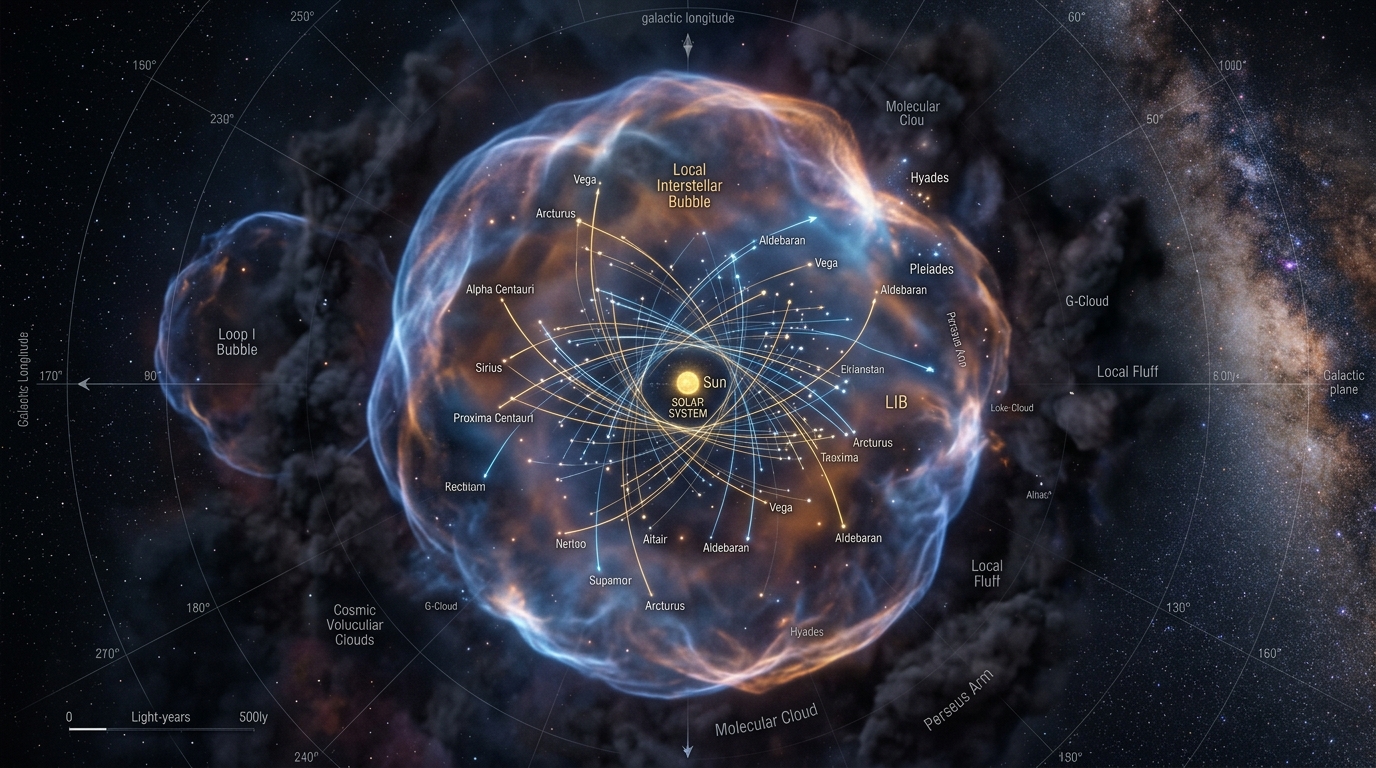
Interstellar space is far from a pristine, uniform vacuum. The solar neighborhood is carved into an intricate hierarchy of multi-phase plasma cavities, expanding superbubbles, shock fronts, and warm neutral clouds. For relativistic interstellar probes and early deep-space communication relays, understanding the fine structure of this Local Interstellar Topography is not merely an astrophysical pursuit—it is an engineering imperative. Interstellar gas densities directly dictate relativistic drag forces, shielding requirements against energetic particle erosion, plasma dispersion on high-bandwidth optical/radio communications, and the physical geometry of the protective heliosphere.
1. The Architecture of the Local Bubble
The Sun currently resides within an expansive, irregularly shaped cavity known as the Local Cavity or Local Bubble (LB). Spanning approximately 300 ext{ pc}(~ 1,000 ext{ light-years}) across the Galactic plane, the Local Bubble is characterized by extremely high temperatures (T ~ 10^6 ext{ K}) and an exceptionally rarefied plasma density (n_e pprox 0.005 ext{ cm}^-3), roughly one-tenth the average density of the galactic interstellar medium (ISM).
Recent 3D dust mapping and ESA Gaia-based astrometric surveys reveal that the Local Bubble is not a static sphere, but an hourglass-like or chimney-shaped structure that opens vertically into the Galactic halo at high northern and southern galactic latitudes (|Z| > 150 ext{ pc}). The boundary of the Local Bubble is delineated by a dense, expanding shell of cold neutral gas and dust clouds, containing prominent star-forming complexes such as the Taurus, Ophiuchus, Perseus, and Corona Australis molecular clouds.
Physical Contrast in the Local Bubble
The core of the Local Bubble maintains an ultra-low plasma density (n_e pprox 0.005 ext{ cm}^-3) at millions of Kelvin, yet embedded within this cavity are discrete, warm neutral/partially ionized clouds (such as the Local Interstellar Cloud and G-Cloud) where neutral hydrogen densities spike by two orders of magnitude (n_H pprox 0.1 ext{--}0.3 ext{ cm}^-3).
2. Supernova Genesis: The Scorpius-Centaurus Driver
The physical origin of the Local Bubble has been definitively traced to episodic core-collapse supernovae within the moving subgroups of the Scorpius-Centaurus (Sco-Cen) OB Association. Located between 100 and 150 pc from the Sun, Sco-Cen is the nearest site of recent massive star formation, divided into three main kinematic sub-clusters:
- Upper Centaurus-Lupus (UCL): Star formation initiated ~ 15 ext{--}17 ext{ Myr}ago.
- Lower Centaurus-Crux (LCC): Star formation initiated ~ 12 ext{--}14 ext{ Myr}ago.
- Upper Scorpius (US): The youngest subgroup, active over the last ~ 5 ext{--}10 ext{ Myr}.
2.1 Energy Injection and Blast Wave Dynamics
Over the past 14 million years, approximately 14 to 20 supernova explosions occurred within these clusters, injecting an aggregate mechanical kinetic energy exceeding E_total ~ 2 imes 10^52 ext{ ergs}into the surrounding ISM. Successive blast waves swept up ambient cold gas into an expanding outer shell, heating the interior cavity via shock thermalization to T ~ 10^6 ext{ K}and maintaining soft X-ray emission (0.1–0.3 keV) observed by ROSAT and eROSITA.
2.2 Terrestrial and Lunar Radioisotope Confirmation
Direct geological evidence of these local supernova detonations exists on Earth and the Moon in the form of elevated concentrations of live iron-60 ({}^60 ext{Fe}, half-life t_1/2 = 2.62 ext{ Myr}) and aluminum-26 ({}^26 ext{Al}, half-life t_1/2 = 0.717 ext{ Myr}). Deep-sea ferromanganese crusts, sediment cores, and Apollo lunar regolith samples exhibit two distinct deposition peaks:
- Primary Event (~2.0 – 3.2 Myr ago): A near-Earth supernova at a distance of 50 ext{--}60 ext{ pc}that contributed directly to the current expansion phase of the cavity.
- Secondary Event (~6.5 – 8.0 Myr ago): An earlier blast wave associated with initial UCL cluster detonations that cleared the primary cavity volume.
3. Neutral Hydrogen (H ext{ I}) Distribution & Density Gradients
The spatial distribution of neutral hydrogen (H ext{ I}) within the Local Bubble is mapped using high-resolution Lyman-lpha(\lambda = 1215.67 ext{ \AA}) and Mg II (\lambda = 2796.35 ext{ \AA}, 2803.53 ext{ \AA}) absorption spectroscopy along sightlines to nearby hot white dwarfs and B-type stars. The total column density N(H ext{ I})is given by the line-of-sight integral:
N(H I) = \int_0^d n_H(s) dsWhile average line-of-sight column densities across the entire Milky Way disk routinely exceed N(H ext{ I}) ~ 10^21 ext{ cm}^-2, sightlines within the Local Bubble exhibit extraordinarily low values, dipping below N(H ext{ I}) pprox 10^17 ext{--}10^18 ext{ cm}^-2along the "interstellar tunnel" toward the star \epsilonCMa (Canis Majoris tunnel).
3.1 Mathematical Density Profiles
Within individual warm cloudlets embedded inside the cavity, the neutral density distribution is modeled via 3D anisotropic Gaussian dispersion tensors:
n_H(r) = n_0 \exp≤ft( - (1 / 2) (r - r_c)^T \Sigma^-1 (r - r_c) )where r_crepresents the cloud centroid coordinates, n_0is the peak central density, and \Sigmais the spatial covariance matrix capturing the cloud's morphological elongation along interstellar magnetic field lines. At the boundary interface between the warm cloud and the hot cavity plasma, the density gradient abla n_His governed by conductive evaporation and radiative cooling equilibrium:
\nabla n_H = - (n_0 / σ^2) (r - r_c) \exp≤ft( - (|r - r_c|^2 / 2σ^2) )3.2 Thermal Pressure Balance
Despite dramatic density and temperature disparities, the warm neutral cloudlets and the surrounding hot bubble plasma exist in near-thermal pressure equilibrium:
(P / k_B) = n_total T = (n_H + n_He + 2n_e) T ≈ 2,000 to 4,500 K·cm^-34. The Solar Micro-Environment: LIC and the G-Cloud Interface
The Sun is currently embedded inside the Local Interstellar Cloud (LIC), a warm, partially ionized cloudlet with dimensions of roughly 5 imes 7 ext{ pc}. The physical properties of the LIC at the heliosphere boundary are:
- Temperature (T): 7,500 ± 1,000 ext{ K}.
- Neutral Hydrogen Density (n_H): 0.19 ± 0.03 ext{ cm}^-3.
- Electron Density (n_e): 0.07 ± 0.02 ext{ cm}^-3(ionization fraction \chi_e pprox 0.27).
- Bulk Flow Velocity Relative to Sun: v_LIC pprox 25.7 ± 0.5 ext{ km/s}pointing toward Galactic coordinates l = 186.4^\circ, b = -16.4^\circ(arriving from the Sco-Cen direction).
4.1 The Impending G-Cloud Transition
Crucially, the Sun is situated at the extreme trailing edge of the LIC, within less than 0.05 ext{ pc}(~ 10,000 ext{ AU}) of the cloud boundary. Moving directly along the Sun's trajectory lies the G-Cloud complex, an adjacent warm interstellar cloud that currently engulfs our nearest neighbor, the Alpha Centauri triple star system (d pprox 1.34 ext{ pc}).
High-resolution spectroscopic mapping indicates that the G-Cloud has a slightly higher bulk speed relative to the Sun (v_G pprox 29.6 ext{ km/s}) and a marginally cooler, denser core (T pprox 5,500 ext{ K}, n_H pprox 0.22 ext{ cm}^-3). Astrodynamic projections indicate that the Solar System will transit out of the LIC and enter either the intercloud transition filament or the G-Cloud boundary within the next 2,000 to 4,000 years, altering the size and cosmic-ray shielding capacity of the heliosphere.
4.2 Interstellar Magnetic Field (ISMF) Geometry
The local interstellar magnetic field, measured directly by NASA's Voyager 1 and Voyager 2 in the very local interstellar medium (VLISM) and calibrated by the IBEX ENA (Energetic Neutral Atom) Ribbon, possesses an average field strength of B_ISMF pprox 3.0 ± 0.5 ext{ }μ ext{G}oriented toward Galactic coordinates (l pprox 227^\circ, b pprox +35^\circ). This magnetic draping shapes the asymmetric nose-to-tail configuration of the heliosphere and modulates galactic cosmic ray flux.
5. Interstellar Medium Zones and Densities Data Table
The table below summarizes the multi-phase physical conditions encountered across the local interstellar environment, from the immediate heliospheric interface through the Local Bubble shell:
| ISM Zone / Morphological Feature | Radial Distance / Extent | Kinetic Temperature (T) | Neutral Density (n_H) | Electron Density (n_e) | Ionization Fraction (\chi_e) | Bulk Velocity vs LSR |
|---|---|---|---|---|---|---|
| Local Interstellar Cloud (LIC) | 0 ext{ to } 3 ext{ pc}(local immersion) | 7,500 ± 1,000 ext{ K} | 0.19 ext{ cm}^-3 | 0.07 ext{ cm}^-3 | ~ 27\% | ~ 26.0 ext{ km/s} |
| G-Cloud Complex (lphaCen Host) | 1.0 ext{ to } 5.0 ext{ pc}(toward Cen) | 5,500 ± 800 ext{ K} | 0.22 ext{ cm}^-3 | 0.09 ext{ cm}^-3 | ~ 29\% | ~ 29.6 ext{ km/s} |
| LIC / G-Cloud Interface Shear Layer | 0.05 ext{ to } 0.8 ext{ pc} | 12,000 ext{--}20,000 ext{ K} | 0.05 ext{ cm}^-3 | 0.12 ext{ cm}^-3 | ~ 70\% | Turbulent shear zone |
| Local Bubble Core Cavity Plasma | 5 ext{ to } 100 ext{ pc} | ~ 1.0 imes 10^6 ext{ K} | < 0.001 ext{ cm}^-3 | 0.005 ext{ cm}^-3 | pprox 100\%(Fully ionized) | Quiescent / thermal expansion |
| Cold Neutral Medium (CNM) Filaments | 60 ext{ to } 120 ext{ pc}(cavity walls) | 40 ext{ to } 100 ext{ K} | 10.0 ext{ to } 100.0 ext{ cm}^-3 | 0.001 ext{ cm}^-3 | < 0.1\% | ~ 10 ext{--}15 ext{ km/s} |
| Warm Ionized Medium (WIM) | 80 ext{ to } 250 ext{ pc} | 8,000 ext{ K} | < 0.05 ext{ cm}^-3 | 0.15 ext{ cm}^-3 | ~ 75 ext{--}90\% | Galactic rotation |
| Loop I Superbubble / Sco-Cen Wall | 100 ext{ to } 150 ext{ pc} | 5 imes 10^5 ext{ K}(shocked) | 2.0 ext{ to } 5.0 ext{ cm}^-3 | 0.5 ext{ cm}^-3 | ~ 20 ext{--}50\% | ~ 25 ext{ km/s}expansion |
6. Engineering & Operational Impacts on Interstellar Flight
Traversing these distinct interstellar zones imposes severe constraints on spacecraft design and mission architecture:
6.1 Relativistic Gas Drag & Sputtering Erosion
For a relativistic craft cruising at velocity v = eta c, the effective ram pressure exerted by the ambient neutral and ionized medium is expressed as:
P_ram = \rho v^2 γ^2 = (m_p n_H + m_e n_e) c^2 β^2 γ^2At eta = 0.20(γ = 1.0206) through the LIC (n_H = 0.19 ext{ cm}^-3), individual atomic impacts carry energies of ~ 19.6 ext{ MeV}per proton. This induces atomic sputtering, lattice dislocation, and dielectric breakdown in forward optical lenses and thermal shielding tiles. While the Local Bubble cavity offers negligible drag (P_ramdrops by a factor of 40), crossing the dense G-Cloud boundary will drastically escalate thermal dissipation and surface pitting rates.
6.2 Plasma Dispersion & Communication Propagation
Free electrons in the ISM disperse radio and laser communications. The frequency-dependent group delay \Delta tacross distance dis proportional to the Dispersion Measure (DM):
DM = \int_0^d n_e(s) ds, \Delta t = (e^2 / 2\pi m_e c) (DM / ν^2) ≈ 4.15 × 10^3 s · ≤ft((DM / pc·cm^-3)) ≤ft((ν / MHz))^-2For optical and ultraviolet laser links (u ~ 300 ext{--}1000 ext{ THz}), dispersion is negligible, but beam phase scintillation induced by electron density turbulence (\delta n_e) at the LIC/G-Cloud shear layer requires adaptive optical wavefront correction at receiver stations.
7. References & Foundational Literature
- Zucker, C., Goodman, A. A., Alves, J., et al. (2022). Star formation near the Sun is driven by expansion of the Local Bubble. Nature, 601(7893), 334–337.
- Frisch, P. C., Redfield, S., & Slavin, J. D. (2011). The Interstellar Medium Surrounding the Sun. Annual Review of Astronomy and Astrophysics, 49, 237–279.
- Linsky, J. L., Redfield, S., & Tilipman, D. (2019). The Three-dimensional Structure of the Local Interstellar Medium. The Astrophysical Journal, 886(1), 41.
- Wallner, A., Feige, J., Kinoshita, N., et al. (2016). Recent additions of supernova-produced 60Fe to the Earth and Moon. Nature, 532(7597), 69–72.
- Breitschwerdt, D., de Avillez, M. A., Feige, J., & Dettbarn, C. (2016). The locations of recent supernovae near the Sun from modelling 60Fe transport. Nature, 532(7597), 73–76.
- Gurnett, D. A., Kurth, W. S., Burlaga, L. F., & Ness, N. F. (2013). In situ observations of interstellar plasma with Voyager 1. Science, 341(6153), 1489–1492.
Verified Primary Sources & Citations
Every empirical claim, economic metric, and technical assertion in this publication is cross-referenced against primary research literature and regulatory records:
-
arXiv:2602.04198 — Fast Solar Gravitational Lens Mission Trajectories ↗
Comprehensive orbital mechanics and propulsion trade study for 650 AU transit before 2040.
-
NASA NIAC Study: Direct Multipixel Imaging of an Exoplanet at 650 AU ↗
Focal line optical architectures and Sundiver perihelion trajectories.
Discussion & Insights (0)
Join the discussion on Career Circle
Sign in or create a free account to post comments, ask questions, and engage with the author.