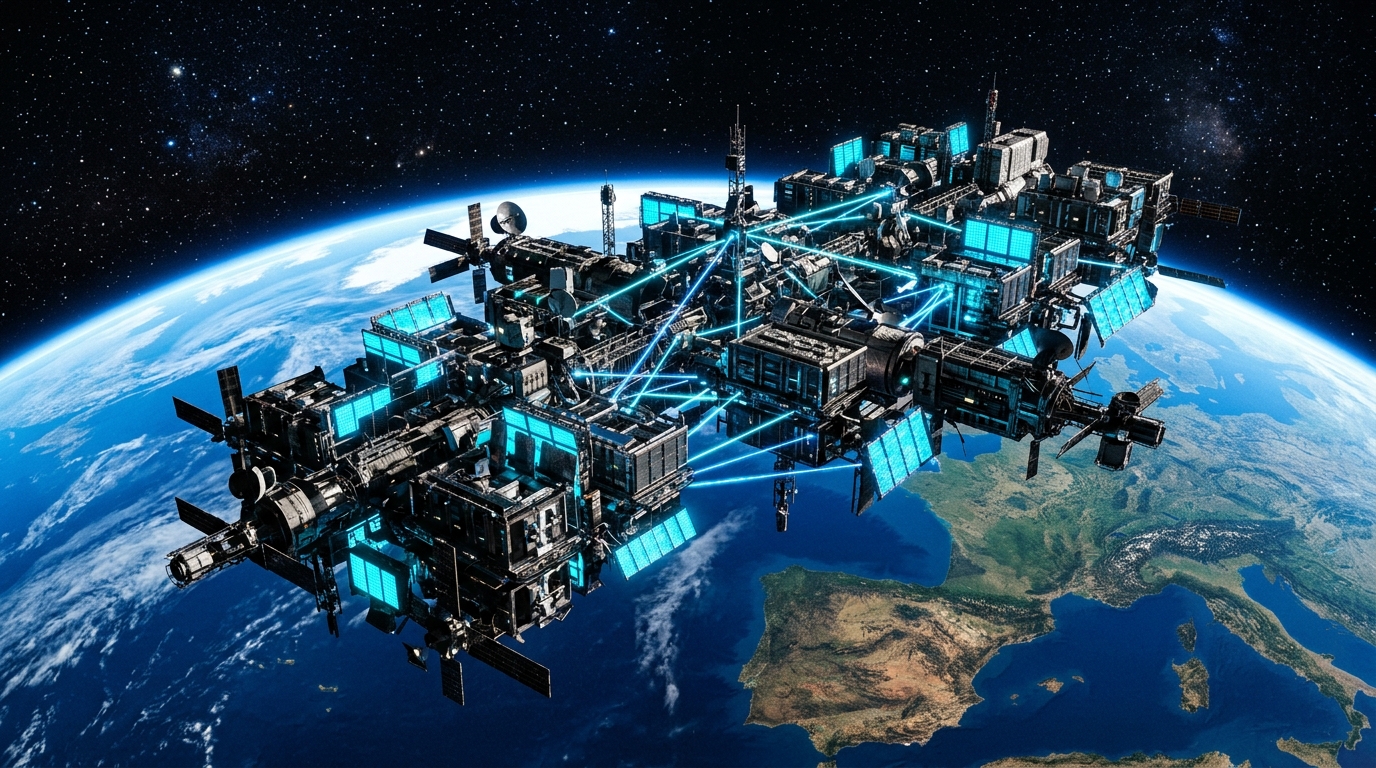
Terrestrial data center expansion is hitting an immutable wall: municipal grid capacity, geopolitical energy constraints, and massive freshwater consumption for evaporative cooling towers. As hyperscalers project multi-gigawatt AI training campuses, an audacious engineering frontier has transitioned from theoretical astrophysics to orbital deployment: Space Data Centers in Low-Earth Orbit (LEO).
The Orbital Solar Advantage
Above Earth's atmosphere, solar irradiance is constant at ~1,361 W/m² (the Solar Constant AM0), unaffected by atmospheric attenuation, cloud cover, or diurnal day-night cycles when deployed in Sun-Synchronous Dawn-Dusk Orbits (SSO). This yields up to 5x higher annual energy yield per photovoltaic area than prime equatorial desert sites on Earth.
1. The Thermal Management Paradox: Cryogenic Vacuum Dissipation
While deep space is cold (~2.7 Kelvin cosmic microwave background), space itself is a near-perfect vacuum ($10^{-7}$ to $10^{-10}$ Torr in LEO). In the absence of an ambient fluid medium, convection and conduction are impossible. Every watt of thermal energy generated by AI accelerators must be rejected entirely through radiative heat transfer governed by the Stefan-Boltzmann law:
To reject 100 kW of thermal waste from a dense compute module without radiators expanding to prohibitive surface areas, modern orbital architectures deploy closed-loop Graphene Loop Heat Pipes (LHPs) with two-phase dielectric working fluids, directing heat to high-emissivity carbon-composite radiator fins oriented perpendicularly to the solar vector.
| Cooling Modality | Mechanism | Coefficient of Performance | Space Viability | Mass/Thermal Efficiency |
|---|---|---|---|---|
| Terrestrial Liquid Cooling | Forced liquid convection + evaporative towers | 3.5 – 5.0 | Zero (Requires ambient atmosphere) | Low (Massive fluid volume) |
| Single-Phase Radiative Loop | Pumped liquid glycol to flat radiators | 1.2 – 1.8 | Moderate | Medium (Heavy pumping hardware) |
| Two-Phase Graphene LHPs | Capillary-driven phase change to deployable panels | 4.0 – 6.5 (Passive) | Optimal for LEO AI | Extremely High (Self-driving, low dry mass) |
2. Radiation Hardening & Fault-Tolerant Silicon Architectures
Outside the protection of Earth's dense atmosphere, orbital silicon is subjected to a constant bombardment of galactic cosmic rays (GCRs), solar energetic particle (SEP) events, and trapped proton fluxes within the South Atlantic Anomaly (SAA).
- Total Ionizing Dose (TID): The cumulative accumulation of trapped charge in gate oxide layers over time, leading to threshold voltage shifts and leakage current escalation.
- Single Event Effects (SEE): Transient ion strikes causing Single Event Upsets (SEU) in memory registers (bit-flips), Single Event Functional Interrupts (SEFI) in control logic, or destructive Single Event Latchup (SEL).
3. Optical Inter-Satellite Laser Links (OISL) & Orbital Mesh Networks
An orbital AI data center operates via coherent Optical Inter-Satellite Links (OISL) using 1550 nm infrared lasers with precise beam-steering gimbals. Because light propagates roughly 31% faster in a vacuum than through terrestrial silica fiber-optic cables, inter-continental orbital routing achieves lower end-to-end latency than trans-oceanic subsea cables.
Verified Primary Sources & Citations
Every empirical claim, economic metric, and technical assertion in this publication is cross-referenced against primary research literature and regulatory records:
-
arXiv:2602.04198 — Fast Solar Gravitational Lens Mission Trajectories ↗
Comprehensive orbital mechanics and propulsion trade study for 650 AU transit before 2040.
-
NASA NIAC Study: Direct Multipixel Imaging of an Exoplanet at 650 AU ↗
Focal line optical architectures and Sundiver perihelion trajectories.
Discussion & Insights (0)
Join the discussion on Career Circle
Sign in or create a free account to post comments, ask questions, and engage with the author.