
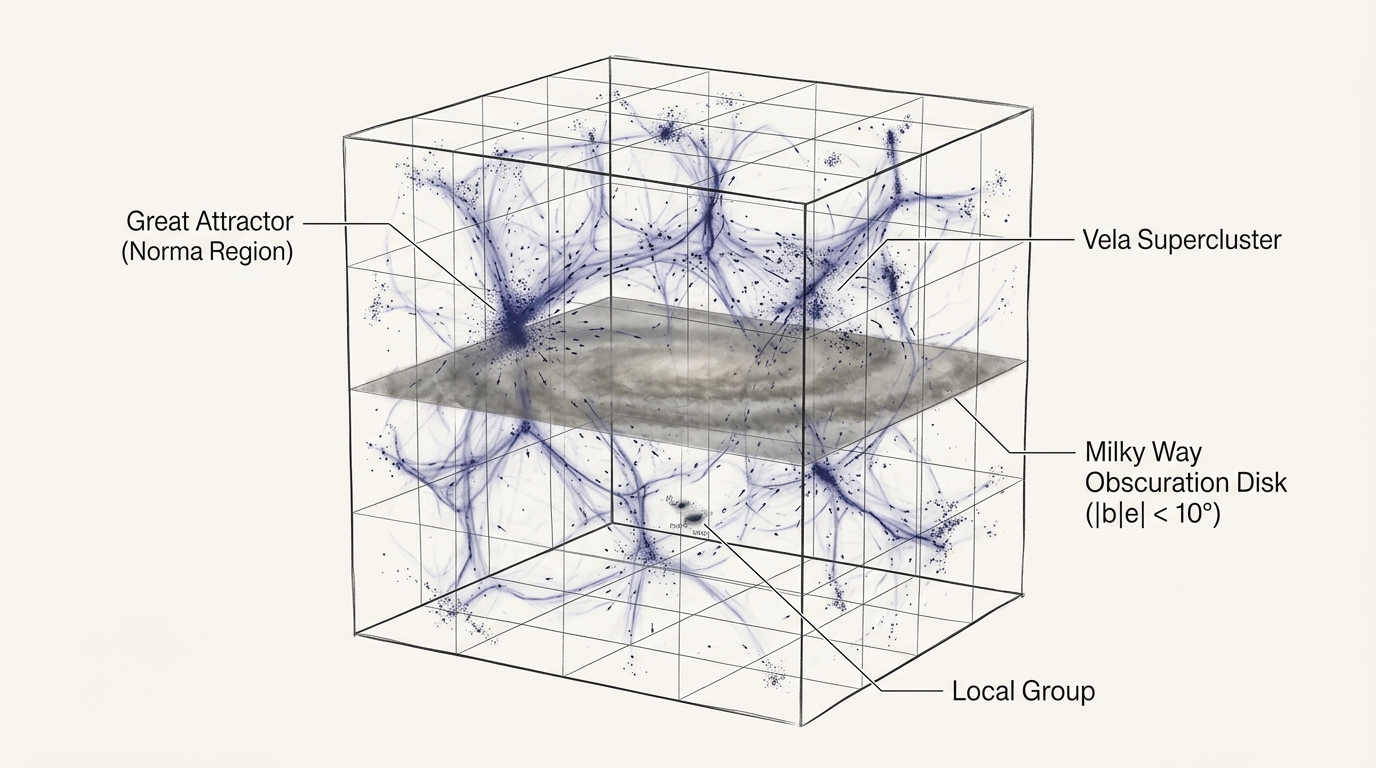
Maps of the nearby Universe are shaped as much by our observing instruments as by the cosmic web itself. Across the sky, the Milky Way occupies a dense foreground screen: interstellar dust obscures optical light, foreground stellar crowding creates severe source confusion, and bright Galactic continuum emission complicates even radio observations. The resulting band is conventionally called the Zone of Avoidance (ZoA). Yet this is an observational limitation on our detection pipeline—not a physical prediction that matter density in the local Universe drops to zero.
This observational blind spot matters dynamically. The Great Attractor, the Norma Cluster, the Local Void, the Hydra–Centaurus complex, the Vela Supercluster, and an intricate network of connecting cosmological walls and filaments lie directly in directions intersected by the Galactic plane. A map that simply blanks the ZoA hides both overdensities and underdensities, leaving downstream cosmological calculations—such as the peculiar motion of our Local Group and the boundaries of gravitational basins—distorted or falsely overconfident.
In this research manuscript, we propose Z–ZOA: a reproducible, uncertainty-aware framework that bridges modern 21-cm blind surveys, near-infrared catalogues, and peculiar-velocity measurements into a unified, probabilistic three-dimensional atlas.
The Core Z–ZOA Formulation
1. The Zone of Avoidance as a Structured Selection Problem
The ZoA cannot be addressed by treating it as a single binary mask. Different astronomical surveys probe different latent galaxy populations with distinct angular resolutions, velocity coverages, flux limits, and failure modes:
- Optical Surveys: Strongly attenuated by dust extinction and obscured by high stellar densities at low Galactic latitude .
- Near-Infrared (NIR) Surveys (e.g. 2MASS ZoA): Substantially penetrate dust columns, yet remain constrained by stellar confusion, source blending, and incomplete spectroscopic redshift follow-ups.
- Blind 21-cm Surveys (Parkes, MeerKAT, ASKAP): Directly pierce the dust screen to detect neutral hydrogen and deliver immediate line-of-sight velocities, but are inherently biased toward gas-rich late-type spirals, underrepresenting gas-poor ellipticals and environmentally stripped cluster cores.
- Peculiar-Velocity Catalogues (Cosmicflows-4): Offer vital line-of-sight distance information , but possess heterogeneous distance indicators and spatially non-uniform sampling.
| Data Layer | Primary Role | Principal Limitations to Preserve |
|---|---|---|
| HIZOA / Parkes | Southern blind baseline; | Single-dish beam confusion, flux completeness, radio continuum effects. |
| MeerKAT Great Attractor SMGPS | Inner-plane high-resolution constraints () | Narrow latitude strip, spatially varying sensitivity, candidate reliability. |
| MeerKAT Vela–SMGPS & Vela–H I | Vela structures through and adjacent to the plane | Mosaic footprint, velocity-resolution limits, gas-rich spiral selection. |
| 2MASS / 2MZOAG | Near-infrared positions and bright-galaxy context () | Extinction correction, stellar crowding, incomplete spectroscopy. |
| WALLABY / ASKAP | Broad southern context and future expansion | Evolving survey footprint, release state, internal vs. public access. |
| Cosmicflows-4 | Independent distances, groups, and peculiar velocities | Heterogeneous distance indicators, correlated errors, grouping assumptions. |
2. Four Core Research Questions and Falsifiable Hypotheses
Z–ZOA is designed around four explicit, falsifiable hypotheses. A null result would demonstrate that existing cosmic flow and acceleration reconstructions are already robust against obscured plane data—itself an invaluable cosmological finding:
(H_1): The Great Attractor wall has a posterior-supported continuous or near-continuous physical structure traversing the inner Galactic Zone of Avoidance after the survey selection functions are modeled.
(H_2): The combined MeerKAT and optical/NIR data favor a two-wall or branched topology for the Vela Supercluster over a single smooth wall.
(H_3): ZoA completion changes cosmic-flow basin boundaries most strongly near the plane and along the Laniakea–Shapley watershed divide, while leaving high-contrast structures invariant.
(H_4): Adding ZoA constraints alters the amplitude and directional alignment of the reconstructed Local Group gravitational acceleration by more than catalogue perturbation uncertainties alone.
3. The Probabilistic Reconstruction Pipeline
The mathematical core of Z–ZOA separates the observable galaxy field from the underlying physical field by explicitly modeling survey completeness:
Let be the probability that a galaxy with Galactic coordinates , distance , mass proxy , and morphological type is detected by survey . The observed count in spatial voxel is modeled as a thinned realization of the latent intensity :
This formulation enforces a critical cosmological distinction: an observationally empty voxel does not equal a physically underdense void. The posterior probability over the latent tracer density field is inferred via:
where represents the harmonized multi-survey catalogue, and denotes selection parameters, observational biases, and nuisance terms. Rather than generating a single arbitrary smoothed map, Z–ZOA samples an ensemble of posterior density realizations to preserve true cosmic variance.
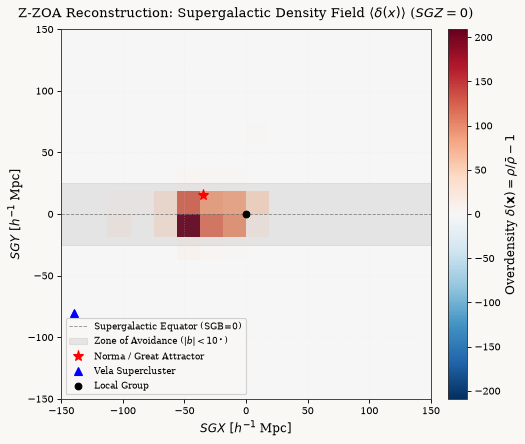
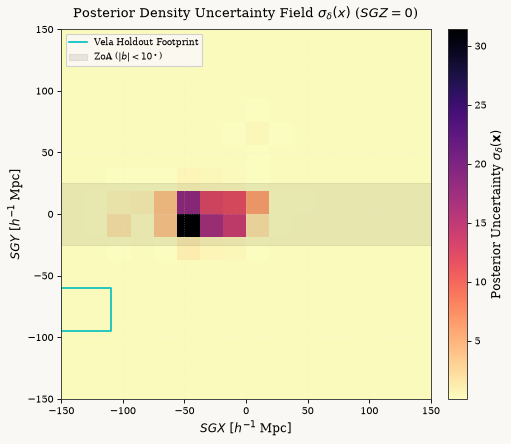
4. From Density to Velocity & Watershed Basins
From each posterior density realization, the corresponding peculiar velocity field is computed in linear perturbation theory:
Measured peculiar velocities from Cosmicflows-4 enter as noisy constraints along the line of sight. By integrating velocity streamlines from a standard grid of seed points to their terminal attractors or sinks, we determine the gravitational watershed boundaries. We quantify the impact of filling the ZoA using label-invariant Jaccard overlaps and boundary displacement metrics.
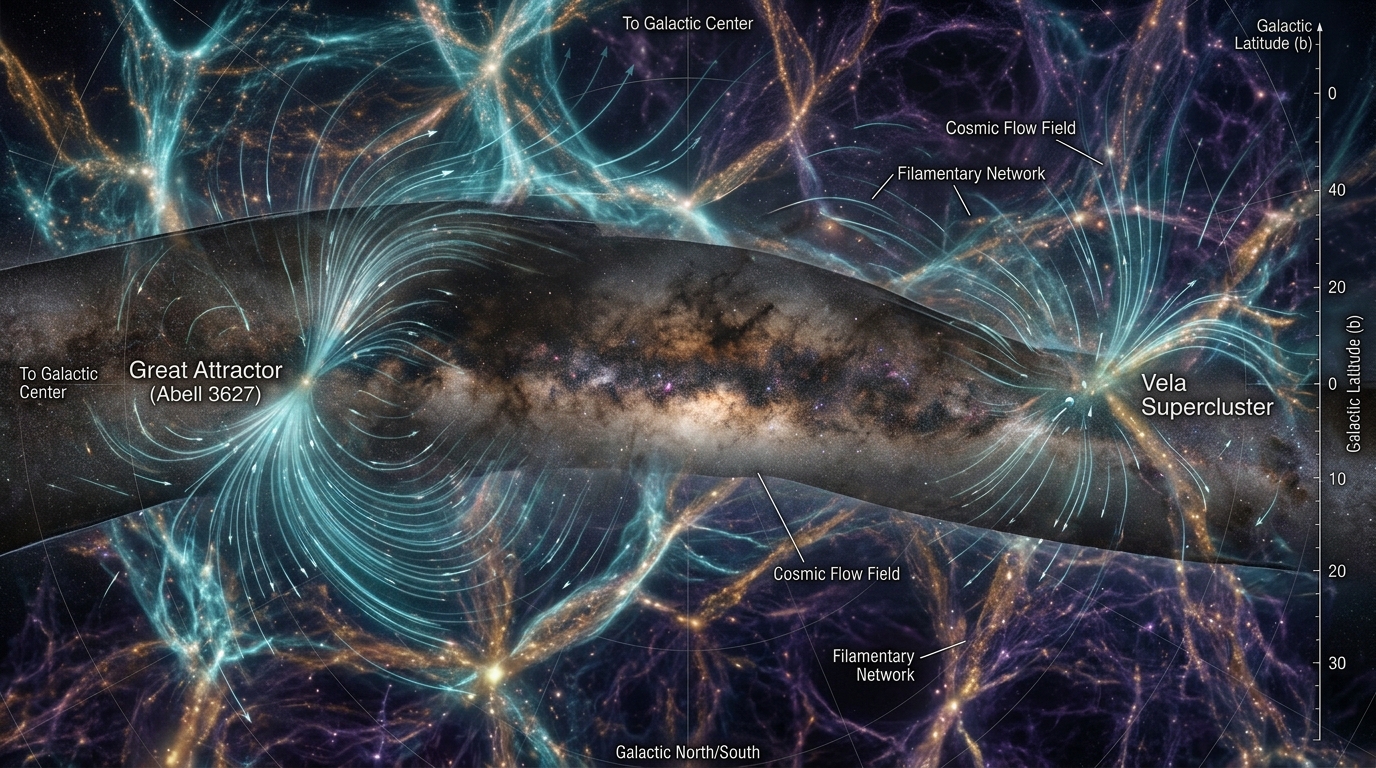
Simultaneously, the predicted gravitational acceleration of the Local Group is evaluated across concentric radii via the dipole estimator:
By comparing with the observed CMB dipole velocity , we determine whether including newly detected ZoA structures resolves the longstanding directional misalignment between the galaxy distribution and the Local Group motion.
5. Staged Analysis Roadmap
To prevent systematic errors from propagating unchecked, Z–ZOA executes in three distinct, staged volumes:
- Run 1 (Nearby Structures: (0 < cz < 12,000 ext{ km s}^{-1})): Anchored by HIZOA, MeerKAT inner-plane detections, 2MASS, and Cosmicflows-4. Validates the catalogue cross-matching and selection function machinery on the Local Void, Hydra–Centaurus, and Norma/Great Attractor regions.
- Run 2 (Vela and Deeper Structures: (0 < cz < 25,000 ext{ km s}^{-1})): Incorporates the deep MeerKAT Vela–SMGPS and Vela– data. Tests whether multiple walls and possible plane crossings constitute a continuous 3D cosmic web.
- Run 3 (Extended Cosmographic Context): Broadens to the full Cosmicflows-4 and WALLABY footprint to evaluate bulk-flow convergence and large-scale tidal fields without imposing artificial boundary truncations.
6. Falsification Protocols and Negative Controls
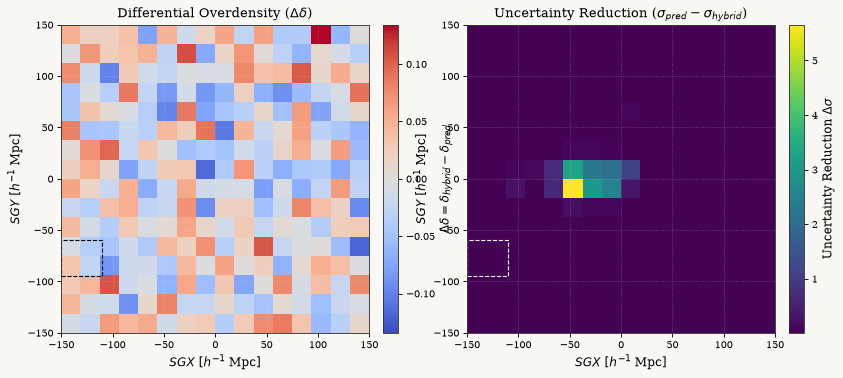
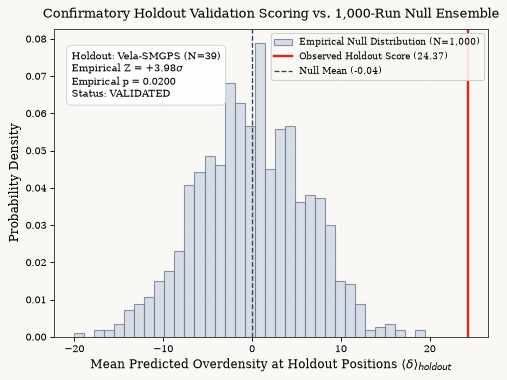
To guard against astrophysical overinterpretation, Z–ZOA subjects all reconstructions to strict validation batteries:
- Mock-Catalogue Recovery: Synthetic cosmological density fields with known filaments and voids are passed through identical survey masks. Any algorithm that fails to recover known injected topology is discarded.
- Leave-One-Survey-Out Jackknifing: Reconstructions are repeated omitting HIZOA, MeerKAT, or 2MASS individually to verify that claimed walls are not artifacts of a single survey instrument.
- Negative Controls: Identical pipeline analysis is run on unmasked high-latitude control regions to ensure the method does not artificially induce filament connectivity.
- Perturbation Stability: Galaxy positions, fluxes, and distance moduli are perturbed within their posterior measurement uncertainties to establish that reported topological transitions exceed observational noise.
7. Conclusion: Making the Hidden Map Measurable
The Zone of Avoidance is best understood as a structured uncertainty problem. The fundamental question is no longer whether galaxies exist behind the Milky Way—decades of dedicated and near-infrared research have proved they do. The true scientific question is how much our remaining observational incompleteness affects our models of the local cosmic web and its gravitational flow fields.
By integrating modern radio surveys with Cosmicflows-style peculiar velocity analysis in a rigorous probabilistic framework, Z–ZOA aims to transform hidden cosmography from speculative interpolation into auditable, reproducible, and dynamically testable science.
Manuscript & Replication Resources
The complete scientific preprint for Z–ZOA: A Probabilistic 3D Atlas of the Zone of Avoidance is available for academic inspection, methodology review, and replication at the official permanent archive:
Permanent URI: https://origindatum.space/docs/Z-ZOA_Manuscript_Zhane_Grey.pdf
@article{grey2026zzoa,
  title={Z--ZOA: A Probabilistic 3D Atlas of the Zone of Avoidance: A framework for reconstructing hidden large-scale structure and testing its dynamical consequences},
  author={Grey, Zhane},
  journal={Z--OA Project Working Papers},
  year={2026},
  month={September},
  url={https://origindatum.space/docs/Z-ZOA_Manuscript_Zhane_Grey.pdf}
}
Discussion & Insights (0)
Join the discussion on Career Circle
Sign in or create a free account to post comments, ask questions, and engage with the author.